Showing posts with label Feedback Cats. Show all posts

Wednesday, February 5, 2020

Don't echo negative thoughts inside your head.

This cat was inspired by an article about the critical voices you might hear inside your head: Silence the Critical Voices in Your Head by Sabina Nawaz.
There’s one debilitating behavior that most of us fall victim to with great regularity: listening to critical voices in our heads. Whether they originate from external criticism or our own fears and doubts, these negative voices tell us we’re not good enough, kind enough, or productive enough. Research shows that echoing negative thoughts inside our heads increases our chances of depression, isolates us from others, and inhibits us from pursuing goals.


Don't echo negative thoughts inside your head.


Saturday, January 25, 2020

Because I feel safe, I can learn from my mistakes.

Because I feel safe, I can learn from my mistakes.


The cat was inspired by this infographic: 2. If students know the classroom is a safe place to make mistakes, they are more likely to use feedback for learning. Complete transcript here.


Wednesday, January 22, 2020

Feedback helps you see the road ahead.

I’ve learned that great feedback creates a roadmap for students; it shows them how far they can go in the mastery of a subject or skill by outlining specific places for improvement or highlighting successful behaviors/techniques. Great feedback pushes students to achieve more and it’s specific in helping them do so.

Feedback helps you see the road ahead.


Saturday, October 13, 2018

Feedback guides my practice.

This growth mindset cat was inspired by an infographic about the learning process; see below.

Feedback guides my practice.


Feedback can be external or internal.

This growth mindset cat was inspired by an infographic about the learning process; see below.

Feedback can be external or internal.


Get feedback from the coach.

This growth mindset cat was inspired by an infographic about the learning process; see below.

To learn, you must act, and then
get feedback from the coach.


Saturday, August 18, 2018

I may fail, but I am never a failure.

See below for the graphic that inspired this cat. Making mistakes and failing to do things right (especially the first time) is what learning is all about! Use feedback from your mistakes and failures so that you can do better next time: you are never a failure when you learn from your mistakes.


I may fail,
but I am never a failure.


Students are never failures. They may experience failure, learn from failure, grow from failure. But they are never defined by failure. Find out more about Andi McNair.

Wednesday, July 18, 2018

I allow myself to do things imperfectly.

This cat was inspired by Celestine Chua's advice on coping with perfectionism.

I allow myself to do things imperfectly.


To find out more, see How To Overcome Perfectionism by Celestine Chua. I've transcribed the graphic below.

How to Overcome Perfectionism
1. Be a healthy perfectionist (Commit to your goals, but don't let failures define you)
2. Remove the all-or-nothing mindset (Allow yourself to do things incompletely and imperfectly)
3. Avoid the perfectionist's mind trap (Don't focus on unimportant information and requisites)
4. Learn to respect and love yourself (You are the only constant in your world)
5. Use your ideals as guides, not absolutes (Don't attach yourself to them)
6. Value your relationships (Allocate time for your relationships)
7. Celebrate the victories and progress made (Every step is a job well done!)
8. Delegate and let go (You don't have to do everything yourself)


This is feedback I can trust.

Check out the graphics below for the key role played by trust in feedback situations.

This is feedback I can trust.


I first found this 2x2 diagram by John Spencer at Twitter:

positive feedback, negative trust: flattery
positive feedback, positive trust: affirmation
negative feedback, negative trust: hating
negative feedback, positive trust: critical feedback


And then in response I saw this more detailed diagram from Kim Scott:

care personally, no challenge:
ruinous empathy -> ignorance, no change

care personally, challenge directly: 
radical candor -> trust, profound change and growth

do not care personally, no challenge:
manipulative insincerity -> mistrust, no change

care personally, challenge directly:
obnoxious aggression -> defensiveness, little change

In the dark I seek the light.

I used a lovely cartoon from Grant Snider (below) to inspire this cat, and Grant Snider explains at his website that he was "inspired by the essay "Notes on Failure" from the excellent book The Faith of a Writer by Joyce Carol Oates."

In the dark I seek the light.


The Specter of Failure
It haunts me while I work. You think you're a writer?
Follows me on walks. You're wasting your time.
Wakes me in the middle of the night. No one will read you.
I try to outrace it. You'll never escape me.
To hide from it.
Still it finds me. Your words are worthless.
I try to shut it out. I'm still here.
It multiplies. Give up! Give up! Give up! Give up!
So from now on, I'm embracing failure.
Stop! It's futile! Who cares? Why? A waste of paper.
Because without its dark abyss, how could I chase the luminous?

Tuesday, July 17, 2018

I find this feedback . . . surprising.

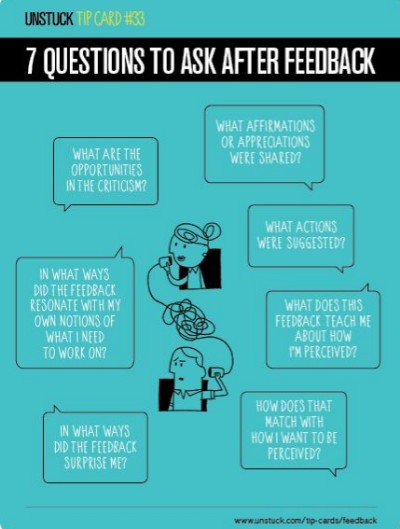
Today's cat is inspired by an infographic from Unstuck; see the infographic and the transcription below.

I find this feedback . . . surprising.


Here is the infographic that I started from:


7 Questions to Ask After Feedback
What are the opportunities in the criticism?
What affirmations or appreciations were shared?
What actions were suggested?
In what ways did the feedback resonate with my own notions of what I need to work on?
What does this feedback teach me about how I'm perceived?
In what ways did the feedback surprise me?
How does that match with how I want to be perceived?

Tuesday, April 4, 2017

I need feedback to help me grow.

This cat was inspired by the great infographic about feedback which you can see below.

I need feedback to help me grow.


I've transcribed the infographic, and there is a a very useful accompanying article here: 21 Components of Effective Feedback.


Sunday, March 5, 2017

Look for patterns in the feedback.

Today's cat was inspired by this article from the ImPraise blog: Overcoming The Fear Of Feedback.

The article discusses how you can develop a "feedback habit" so that you can effectively process the feedback you receive, looking for keywords and patterns, so that you can then use the feedback in order to improve your performance.

Look for patterns in the feedback.


Monday, February 27, 2017

Feedback tells me to try harder.

This item was inspired by an article in the InPraise blog: Overcoming The Fear Of Feedback.
People with growth mindsets, on the other hand, are more likely to take risks and overcome obstacles by seeing failure as a signal to try harder, rather than time to give up.

Feedback tells me to try harder.


Wednesday, February 22, 2017

Find the reason why you made a mistake.

This cat was inspired by this Edutopia article: Teaching Students to Embrace Mistakes by Hunter Maats and Katie O'Brien.
Mistakes happen for concrete reasons. A student didn't memorize all the requisite facts, didn't execute the steps of a process, or perhaps just ignored the directions. The red "X" is just a simple assessment of the actions that student took -- actions he or she can easily fix next time. Sharing that clarity and causality with your students is the best way to teach deliberate practice, instill motivation and help them develop a more constructive relationship with mistakes. 

Find the reason why you made a mistake.


Thursday, February 16, 2017

Feedback is a relationship: you and me.

This cat is inspired by The Simple Phrase That Increases Effort 40% by Paul Sohn, where he is quoting Daniel Coyle:
I love how Coyle follows up with these insights: “The key is to understand that this feedback isn’t just feedback — it’s a vital cue about the relationship. The reason this works so well has to do with the way our brains are built. But when we receive an authentic, crystal-clear signal of social trust, belonging, and high expectations, the floodgates click open.”

Feedback is a relationship: you and me.


Tuesday, February 14, 2017

Feedback tells you that you can go higher.

This can was inspired by 5 Tips For Taking Feedback Like a Champ by Megan Bruneau.
I was recently talking to a professional athlete friend, who was sharing the areas of his game that needed work. In response to his coaches' feedback, he felt anxious, discouraged, and ashamed. "But isn't it wonderful," I told him, "That you have areas to work on! It means you haven't reached the peak of your game and can still improve as a player. Imagine if you had no areas you could improve upon? You would have maxed out your potential and wouldn't have the chance to secure a starting position!" The same goes for our career trajectories. Remind yourself that those deficiencies and growth areas mean you still have potential to develop — and there's no telling what you're capable of once you acknowledge and bring attention to those areas!

Feedback tells you that you can go higher.


Sunday, February 12, 2017

Feedback is helpful: don't fear it.

This cat was inspired by a post at the Impraise blog: Overcoming The Fear Of Feedback.
Stanford Professor Carol Dweck’s studies into what she terms ‘fixed and growth mindsets’ also provide valuable insights into this fear. According to her research, people with fixed mindsets view their skills as constant personal traits, while people with growth mindsets view their skills as malleable abilities which can be improved. For example, children who have been praised for being smart throughout their lives may face difficulties improving after receiving a bad grade on an exam. However, children who have been praised for getting good grades based on their hard work and dedication are more likely to see a bad grade as an opportunity to learn more. When we associate abilities with a part of our identity, receiving constructive criticism can feel more like a personal attack. People with growth mindsets, on the other hand, are more likely to take risks and overcome obstacles by seeing failure as a signal to try harder, rather than time to give up.

Feedback is helpful: don't fear it.


Feedback helps you know how far you can go.

This cat was inspired by How To Give Students Specific Feedback That Actually Helps Them Learn by Justin Chando:
I’ve learned that great feedback creates a roadmap for students; it shows them how far they can go in the mastery of a subject or skill by outlining specific places for improvement or highlighting successful behaviors/techniques. Great feedback pushes students to achieve more and it’s specific in helping them do so.

Feedback helps you know how far you can go.